Iron Nitride Magnets (Fe₁₆N₂): How Should Companies Read This Supply-Chain Reset?
Magnets may look mature, but electrification and geopolitics are rewriting supply assumptions. What does Fe₁₆N₂ mean strategically?
For most manufacturers, magnets have long been treated as a "mature and hard-to-disrupt" commodity component. Yet as electrification accelerates and geopolitical risk becomes a persistent variable, this seemingly stable critical part is approaching a structural inflection point.
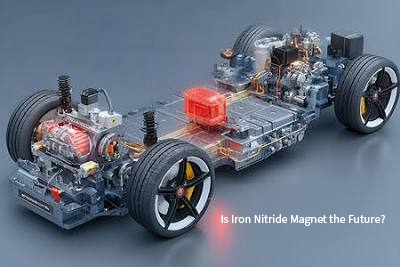
In 2025, U.S.-based Niron Magnetics—backed by a dedicated US$17.5 million government award—commissioned the world’s first commercial iron nitride (Fe₁₆N₂) permanent magnet plant. The strategic significance is not simply "a new material", but the first credible mass-production path for high-performance magnets that does not rely on rare earths.
From "cost" to "risk management": how magnet material decisions are changing
Over the past decade, the core challenge of NdFeB magnets has never been price alone—it is the extreme concentration of supply. For automakers, motor OEMs, and high-end equipment manufacturers, magnets are effectively an invisible geopolitical risk.
Iron nitride magnets use only iron and nitrogen, enabling a highly localized supply chain. More importantly, their theoretical maximum energy product can be roughly 18% higher than NdFeB, with improved stability at elevated temperatures. That makes Fe₁₆N₂ not only an alternative, but a candidate to redefine the balance between performance and supply security.
Why are automakers the first to test?
Stellantis and Samsung have reportedly evaluated iron nitride magnets in traction motors and audio systems—hardly by chance. With relatively low coercivity, Fe₁₆N₂ is particularly attractive for variable-flux motors (VFM). The value of VFM is less about a headline efficiency number and more about system-level optimization:
- In high-speed cruising conditions, losses can be reduced, improving EV driving range by 20–30%.
- This means the same battery capacity can deliver stronger product competitiveness—or allow a re-optimization of cost and weight in future vehicle platforms.
After 2027 mass production, what should companies consider?
Niron targets full-scale production in 2027. This does not imply NdFeB will be displaced quickly. The real pivot is that magnets may shift from a "single-path" dependency to a strategic resource with multiple viable options. For procurement and product strategy teams, the question becomes: how do we design a portfolio approach across performance, cost, and geopolitical resilience?