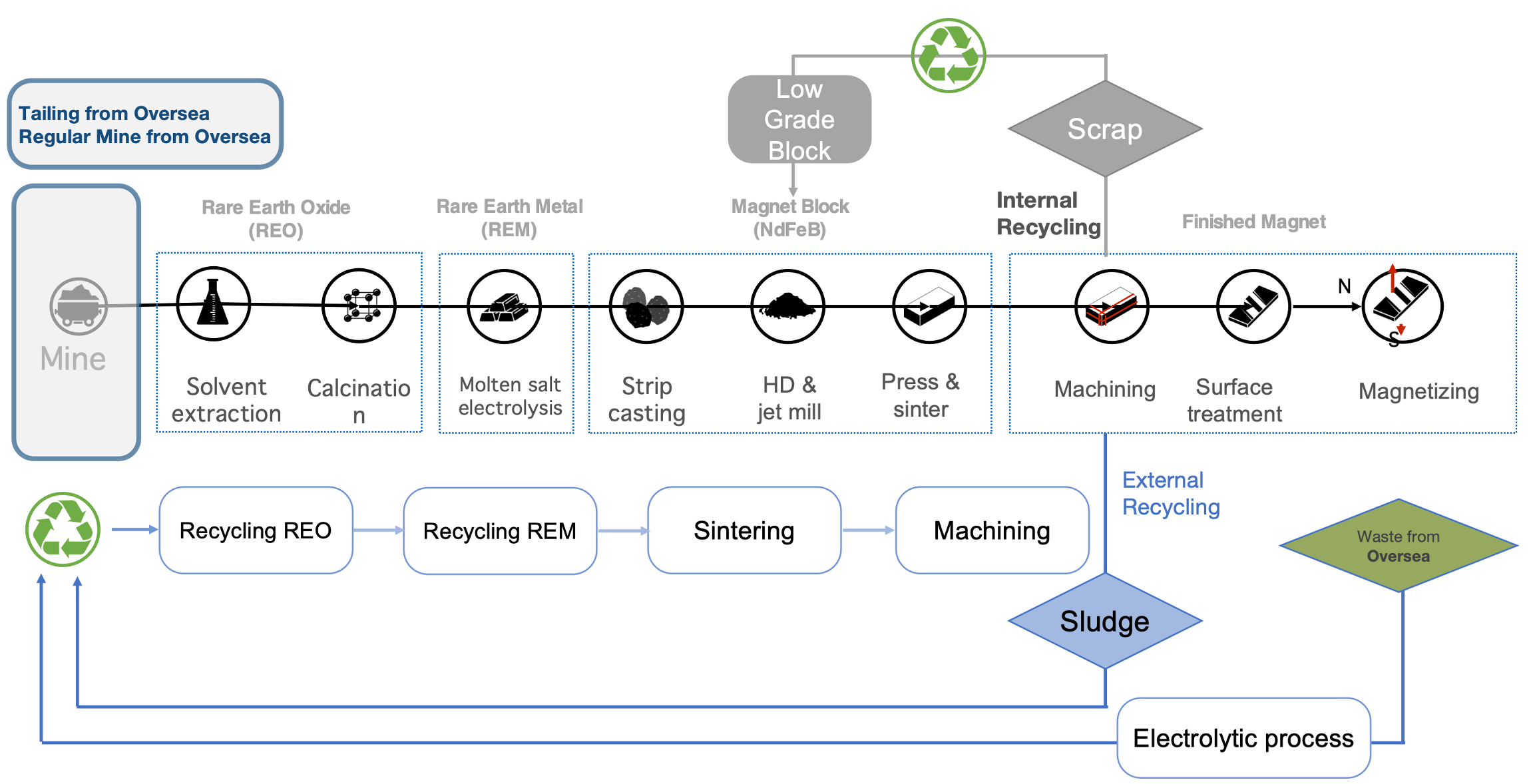
NdFeB End-to-End: A Vertically Integrated Process Walkthrough
A full technical overview of sintered NdFeB from mining and refining through alloying, sintering, coating, magnetization, and recycling.
Sintered NdFeB is the strongest commercially available permanent magnet material today. Its production is a highly complex, tightly coupled, end-to-end vertically integrated process. From mining to final magnetization, each step affects performance stability and quality. Below is a technical walkthrough of the NdFeB ‘end-to-end’ flow:
Mine
Key points: Extract rare-earth ore and perform beneficiation (e.g., flotation) to concentrate rare-earth minerals and remove gangue/impurities. This step increases rare-earth concentration to a level suitable for downstream refining.
Output: Rare-earth concentrate (powder) containing neodymium and other REEs. REO content can rise from only a few percent in raw ore to ~60%+ in concentrate—serving as feedstock for extracting neodymium and related elements.
Solvent Extraction
Key points: After acid/alkali leaching of concentrate, multi-stage counter-current solvent extraction separates neodymium from chemically similar rare-earth elements using selective extractants. This is the primary industrial route to high-purity single rare-earth products.
Output: Purified neodymium solution/precipitate (e.g., NdCl₃ solution), converted via precipitation to intermediates such as neodymium hydroxide or neodymium oxalate, then processed to oxide for metal production.
Calcination
Key points: Calcine purified intermediates at high temperature to remove water/volatiles and convert to oxide. Temperature control ensures the correct chemical form and purity for electrolysis.
Output: Neodymium oxide (Nd₂O₃) powder—high-purity rare-earth oxide used as the direct feedstock for molten-salt electrolysis.
Molten Salt Electrolysis
Key points: Convert oxides into electrolyzable salts and electrolyze at high temperature. Neodymium ions are reduced at the cathode to metallic neodymium, typically under inert atmosphere to prevent oxidation.
Output: Metallic neodymium (Nd) and other required metals—high purity, low oxygen—often as ingots or granules.
Strip Casting
Key points: Melt Nd, Fe, B and additives in a vacuum induction furnace to form a homogeneous melt. Rapidly cast onto a rotating copper wheel for fast solidification, producing a fine, uniform microstructure.
Output: NdFeB alloy flakes/strips (~0.3 mm thick) with near-final composition and fine dendritic structure.
Hydrogen Decrepitation & Jet Milling (HD & Jet Mill)
Key points: Expose alloy strips to high-purity hydrogen to induce embrittlement and cracking along grain boundaries. Then jet-mill under inert gas to micrometer powder (~3–5 μm) with controlled distribution.
Output: NdFeB fine powder with adequate flowability and surface area for subsequent compaction and sintering.
Press & Sinter
Key points: Compact powder in a strong magnetic field to align easy magnetization axes. Vacuum sinter at ~1000–1100°C to densify via solid-state diffusion and remove porosity.
Output: Sintered NdFeB magnet blank with aligned grains and high magnetic performance potential.
Machining
Key points: Cut/grind the sintered blank to precise dimensions and complex geometries using diamond grinding, wire EDM, etc., while controlling stress to avoid chipping/cracking.
Output: Machined magnet parts meeting dimensional and surface-finish requirements.
Surface Treatment
Key points: Apply protective coatings to improve corrosion resistance—commonly electroplating (Ni–Cu–Ni), electroless plating, epoxy coating, etc.—forming a dense barrier layer.
Output: Coated magnets with significantly improved corrosion/weather resistance and enhanced appearance.
Magnetizing
Key points: Apply a high-intensity pulsed magnetic field in a magnetizing fixture to reach saturation. Choose axial, radial, or multipole magnetization as required.
Output: Finished magnets with the intended pole orientation and strong magnetic field.
Internal Recycling
Key points: Demagnetize off-grade parts and machining scrap, then remelt or pulverize to feed back into upstream steps—reducing waste.
Benefit: Higher material yield and a closed-loop process for efficient resource utilization.
External Recycling
Key points: Treat magnet sludge via dedicated hydrometallurgy/electrolysis. Dissolve rare earths, precipitate and recover them for reuse—typically performed by specialized external processors.
Benefit: Resource recovery for fine waste streams, maximizing waste reduction and circularity across the full process.