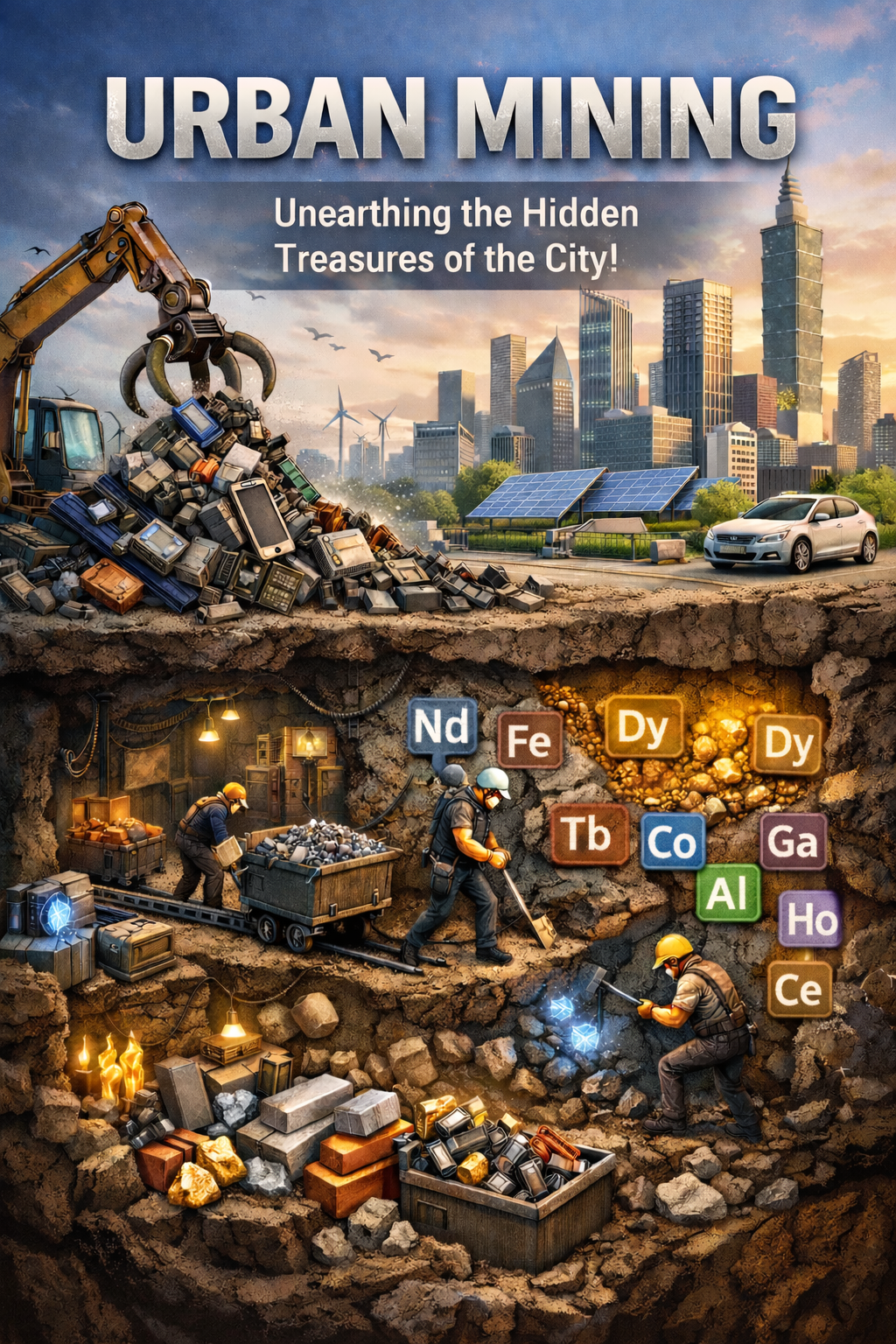
The “Rare‑Earth Mine” Hidden in Cities: How NdFeB Recycling Is Changing the Game
From e-waste to high-performance magnets: how urban mining, hydrogen decrepitation, robotic disassembly, and precision refining reshape NdFeB resilience and ESG competitiveness.
As digital transformation and the energy transition accelerate, one material has become the "vitamins of modern industry"—powering everything from smartphone haptic motors and hard-disk drives to the traction motors of electric vehicles: the neodymium–iron–boron (NdFeB) permanent magnet.
But as global dependence on rare-earth resources reaches an unprecedented level, a new concept is quietly reshaping the rules of manufacturing: "Urban Mining."
Why do we need "Urban Mining"?
Traditional rare-earth mining often comes with a high environmental cost. Production can generate large volumes of acidic wastewater and, in some cases, radioactive by-products—creating long-term pressure on environmental governance and supply-chain compliance.
"Urban Mining" refers to recovering valuable materials from end-of-life electronics (E-waste). For magnet manufacturers, it is more than an environmental responsibility—it is a lever for supply-chain resilience:
- High resource density: Rare-earth content in end-of-life motors can be higher than that of many natural ore bodies.
- Lower carbon footprint: Recycled magnets typically carry far lower emissions than primary mining—aligned with ESG-driven procurement.
- More stable supply: Reduced dependency on single-origin sourcing and price volatility, improving predictability.
Turning waste into value: three enabling technologies for NdFeB recycling
Recycling end-of-life magnets into high-performance material has progressed rapidly in recent years, moving toward scalable, industrialized production:
1) Hydrogen Decrepitation (HD)
NdFeB absorbs hydrogen and expands, causing the magnet to crumble into powder. After re-sintering, magnets with performance close to primary material can be produced with lower energy intensity.
2) Automated robotic disassembly
AI vision combined with robotic arms enables precise location and extraction of magnets from hard drives, motors, and consumer electronics—transforming a labor-intensive process into a scalable recycling line.
3) High-precision refining
Advanced hydrometallurgy or electrochemical separation can recover neodymium, praseodymium, dysprosium, terbium and related elements as high-purity oxides, ready for re-entry into the supply chain.
What it means for manufacturers and customers
For magnet-processing companies, "circular economy" is no longer a slogan—it becomes part of product competitiveness. When customers ask "Is the material source sustainable?" or "How do you mitigate rare-earth price swings?" an integrated urban-mining capability is an evidence-based answer.
With recycling and regeneration technologies, we can offer greener and more stable material options, and work with customers on decarbonization and supply-chain risk management.
Closing: from consumption to circulation
In the future, the best "mines" may not be deep in the mountains, but within our cities and recycling networks. Urban mining for NdFeB magnets represents not only technological progress, but also an industrial mindset that respects resources and protects the planet.